8tracks goes where you go

Internet radio is awesome generally because you get highly relevant programming yet don’t have to go to the trouble of compiling your own playlists.  And by giving people who know & love music a platform for tastemaking, 8tracks delivers the highest relevancy – the right music for any taste, time and place.

But to accomplish this mission, 8tracks also has to be available everywhere, at any time.  You can already listen from your desk (web), on the go (iPhone, Android, Windows, Blackberry) and in your living room (Sonos).  It’s conveniently-delivered music without the grunt work – so you can go to 8tracks radio, press play, and add pleasant sounds to your daily routine effortlessly, integrating it as part of your life. Because radio lends itself to multi-tasking, listeners can feel good about bobbing their heads to great tracks all over the place, from morning until night.

However, we’ve historically been absent from one key listening scenario:  the car, which today represents more than a quarter of all radio listening. That’s why we’ve partnered with Aha Radio, which will bring 8tracks to the automobile dashboard. By the end of 2013 Aha Partners will be integrated into more than 40+ models of vehicles, including Acura, Chrysler, Toyota, Ford, Honda, Porsche and Subaru. Get ready for a more accesible 8tracks, as we add more ways to listen from your vehicles, and beyond.

Case in point:  take a look at my typical day, and you’ll see that 8tracks fits into my life almost 24/7. (Full disclosure: I may or may not be lying about a morning workout being typical.)

7:45 am – Wake up groggy and tired. Turn on a motivating mix to fight the grump inside of me.

8:30 am – Run as fast as I can to catch my bus, go to the gym, break a sweat.

10 am to 7 pm – Work a lovely day from 8tracks headquarters.

8 pm to 10 pm – Read a book, catch up with my mom on the phone, maybe art journal or stalk exes on the interwebs.


11pm – Venture off to dreamland.

How to get one million plays on 8tracks

  • Step 1: Publish a great mix in 2009.
  • Step 2: Wait four years until 8tracks clocks 5 million listeners per month.
  • Step 3: Be proud; you’re an 8tracks millionaire.

Today’s post celebrates the first 8tracks mix to reach over one million plays, a mix which was published in February 2009 and has steadily become the all-time most played mix on the site.

What is it about this mix that’s so compelling to so many listeners? The playlist is a sweet compilation of indie rock songs by lytebryte25, with the evocative title “songs to lie on your bed and stare at the ceiling to.” Along with some well-chosen artwork, it’s this winning combination of a perfect mood, a specific setting, and well-crafted playlist that keeps people coming back to hear your selections.

That’s one of the special things about 8tracks:  you may not know exactly what you want to hear, but if you want some sounds to escape while you stare upwards contemplating existence, or while you sweat, dance, mourn, laugh, or just live, someone out there has made a playlist just for you.

Curious about what other mixes have blown up on 8tracks? Take a look at the top 10 most played 8tracks playlists of all-time:

Thanks to our excellent, dedicated DJs – the curators on the 8tracks network – nearly 800,000 mixes have been published since 2008.  And their audience continues to grow: since 8tracks raised funding in August 2011, both the number of listeners per month and hours of listening per listener per month have tripled, resulting in a nearly 10X increase in total hours streamed, which just topped 22m in April.  Over the same period, listening on mobile has increased from 1% to now 50% of all hours streamed.

Thank you DJs, listeners, raging fans and supporters for being part of the journey as we seek to offer the best music for any taste, time and place. A million plays is just the start of the growth you’ve helped us achieve!

New plugins for WordPress & Joomla

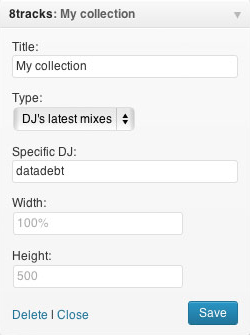
The new WordPress widget interface.

8tracks DJs and listeners have long had the ability to embed mixes in their own blog or website. But given all the quality blogging and CMS platforms out there, we thought we could offer something more robust, plus give a little love back to the developer community. To this end, we’re please to announce the launch of our first set of official Open Source plugins.

First is an update to our WordPress plugin by Jonathan Martin. You can now embed single mixes as well as entire mix collections – these can be all the mixes you’ve personally published, mixes by your favorite 8tracks DJ, or mixes tagged with your favorite combinations of genres and moods.

Second is a brand-new Joomla module from Emir Sakic, which includes all the functionality of our WP plugin plus the ability to specify the pages on which you’d like the mixes to be displayed, and the ability to customize their placement on a page-by-page basis.

Feedback, comments, and feature requests that could make these plugins more useful to the community are most welcome.  And any developers who are interested in helping us build plugins for other platforms, send a note to info@8tracks.com. Thanks and enjoy!


8tracks radio WordPress plugin
Download the WordPress plugin
8track radio joomla module
Download the Joomla module


Finally, here’s the WordPress plugin in action in a blog post using a collection of playlists: 

The Genesis of 8tracks

David being bicoastal

To kick off the new 8tracks blog, I thought it’d be useful to explain how I first arrived at the concept behind the business. While 8tracks was founded in October 2006 and launched in August 2008, its origin dates back to a business plan I wrote some years earlier.

In 1998, after 3 years in London, I moved back to the States to attend business school at Berkeley. I’d noted in my application that I wanted to start an internet music company, but I didn’t really know of what sort. Real Networks, Liquid Audio and N2K were companies I’d uncovered when researching whether music could be delivered on the internet, and Michael Robertson’s MP3.com would emerge shortly after I started at Berkeley. But it wasn’t until September 1999 that I found my real inspiration: Napster.

Downloading anything you could think of was pretty cool. But what happened once that was accomplished? What was next? For me, the most compelling feature of Napster 1.0 was the “hotlist” button. After downloading something interesting or a bit obscure, I could click on the “hotlist” button next to the uploader’s name to reveal the other music on his hard drive. It was, for me, the first example of *social* music discovery on the web. Admittedly, since the files weren’t sorted in any meaningful way, it was quite unorganized. But I knew there was something big there.

At the same time, I was listening to a lot of the electronic music I’d come to love in the clubs of London. It was intriguing that fans of these myriad styles often didn’t know or follow the artists actually creating the songs. Because there were so many fragmented producers of electronic music, the DJ served as listeners’ focal point. Facing a nearly infinite catalog of music now available via Napster, listeners needed a way to find new stuff they’d like, and I thought there could be a way to replicate this DJ paradigm online.

So, during the fall of 1999, I wrote a plan for a business I called “Sampled & Sorted” as part of a media management class. The name sought to describe literally the value proposition a DJ on the service would offer to listeners: sampling a bunch of music in advance, and sorting the best tracks into playlists that would be of interest to those with shared tastes. But the name also referenced certain key elements of dance music culture — the fact that a lot of electronic music is created from samples, and the oft-heard UK clubgoer’s query: “You sorted, mate?”

The plan outlined a service on which DJs would create profiles, including playlists and photos, and link to others on the service whose taste they respected. Listeners could create their own profiles and tune into DJs’ playlists. The Digital Millennial Copyright Act had been enacted about a year earlier, and its compulsory license for webcasting seemed like the right way to offer a free, legal, ad-supported, radio-like experience. In short, Sampled & Sorted would offer what would later come to be known as a social network, but focused first on streaming electronic music and eventually on all music.