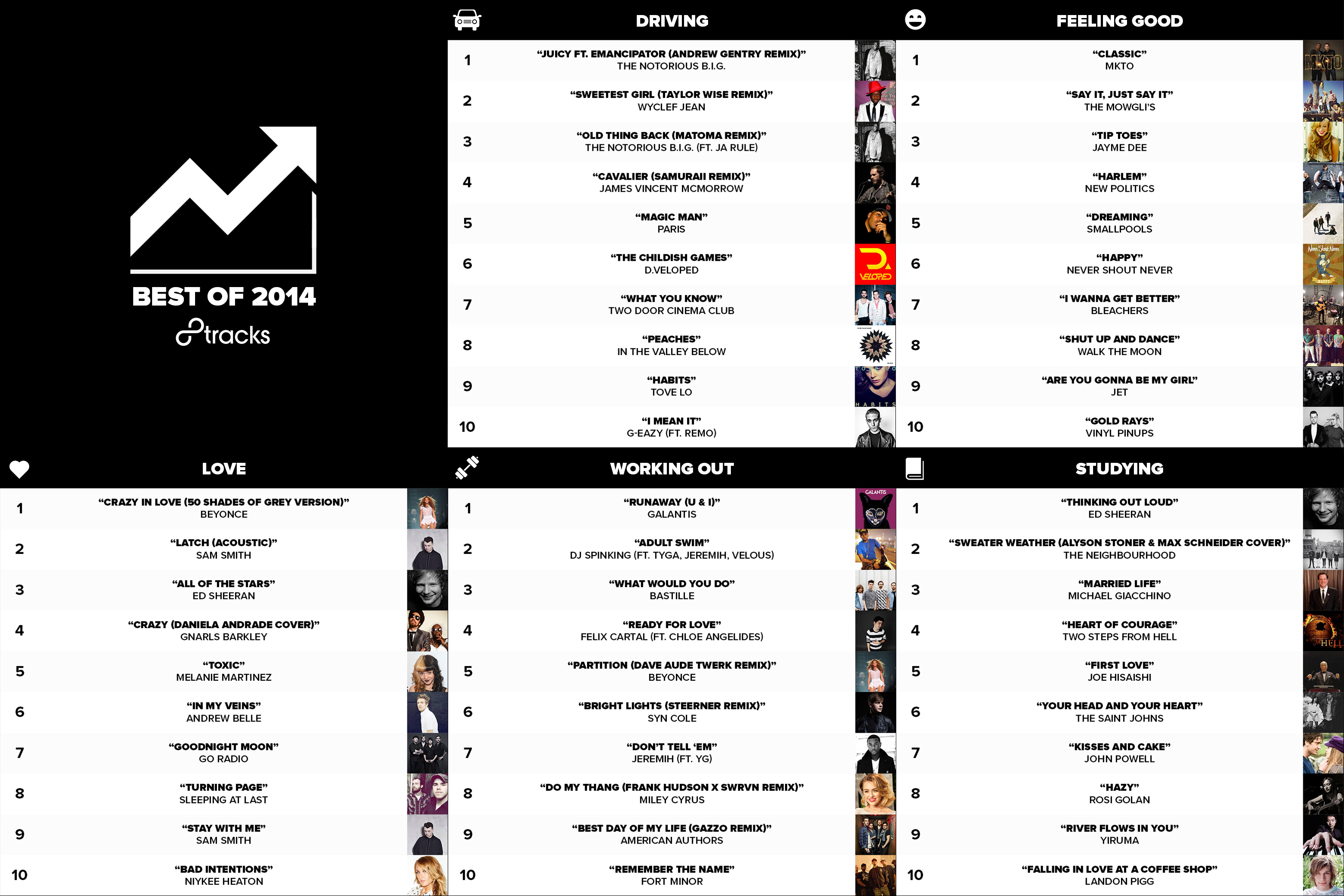
Ever wondered what the best music is for driving? How about working out? We decided to find out. Looking at this past year, we combed our listeners’ feedback across our 360 million hours of streaming to uncover their favorite artists and songs for certain activities and moods.
Looking across tens of thousands of playlists for popular tags like driving, feeling good, working out, studying and in love, we found the top 10 songs that our listeners shared and enjoyed the most for each respective tag in 2014.
And voila! Today we’re launching 8tracks Charts, a collection of playlists that chart the top 100 songs for some of our listeners’ favorite moments.
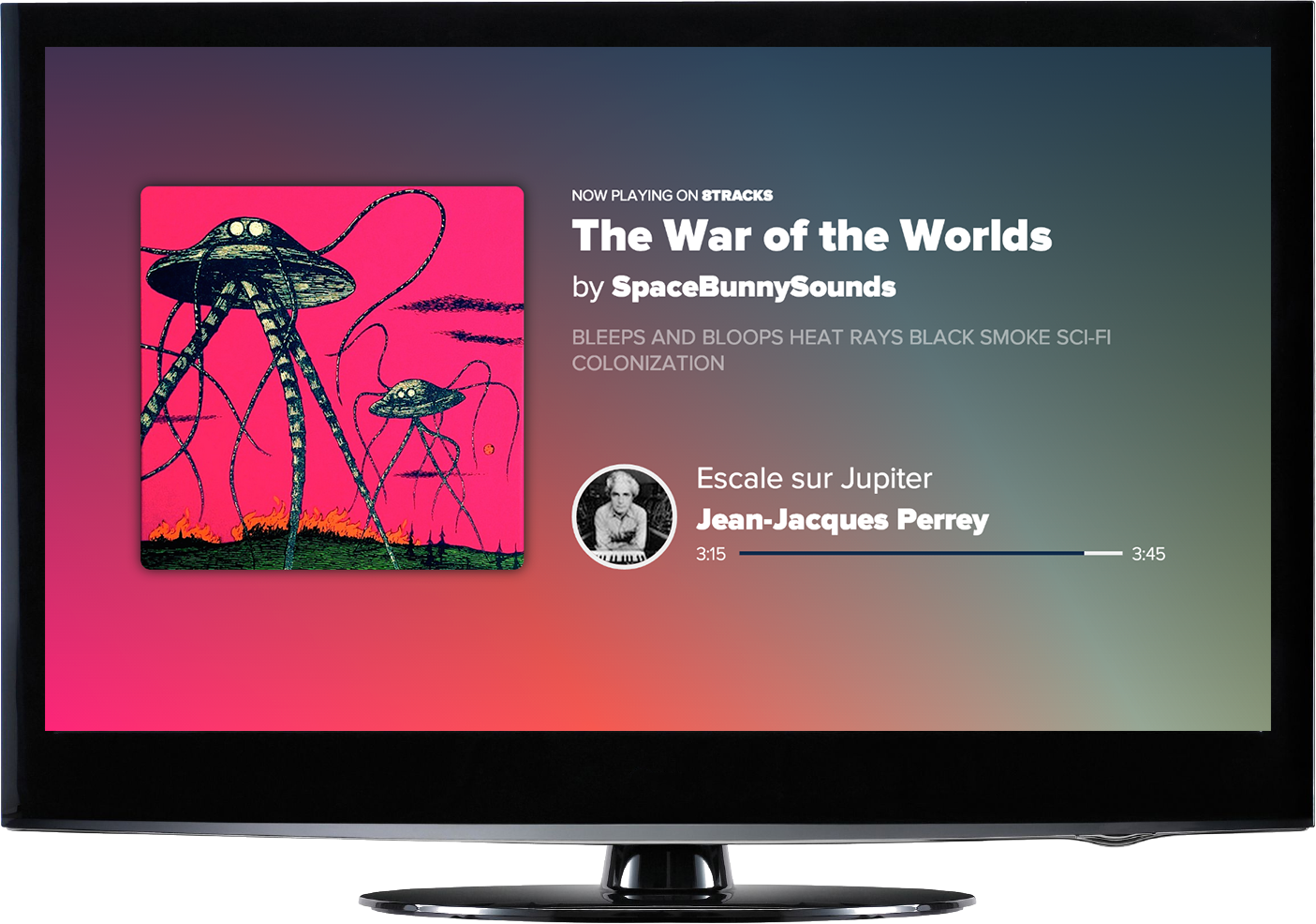
Today we’re excited to bring a little bit of holiday magic into your lives. Specifically the type of magic that allows you to beam 8tracks playlists from your laptop to your TV. You might call it witchcraft, but actually it’s 8tracks Chromecast compatibility – now on web.
That’s right, everyone – as of today if you have a Chromecast setup you can play 8tracks playlists on your TV while controlling them from your browser. So if you’re in the kitchen making a crazy awesome holiday meal, but still want to be in charge of the music (which you should be, you’re cooking for everyone in this hypothetical situation), then you can still have complete control. It’s your domain.
To try it out, download the Chromecast extension if you haven’t already, then launch the Chromecast player on your TV from any 8tracks playlist page.
It’s December, everyone, which means the time has come to reflect on an amazing year in music. We thought about just sharing some of the tracks we loved from 2014, but we think we have something way better: a whole collection of playlists assembled by the record labels, artists, and blogs responsible for sharing and creating some of this year’s best music.
Collecting picks from our friends at Warp, UltraMusic, Domino, Polyvinyl, Drowned in Sound, and many more, our Best of 2014 is (we think) the definitive collection and the last word on the year’s most exciting music, chosen by the folks who make it happen.
Here at 8tracks, we like to think of ourselves as matchmakers. We help people who love music share music–with people who love to listen to music. That’s why today we’re excited to offer three new tools (none of which is a fiddle, though we do serenade new hires this way).
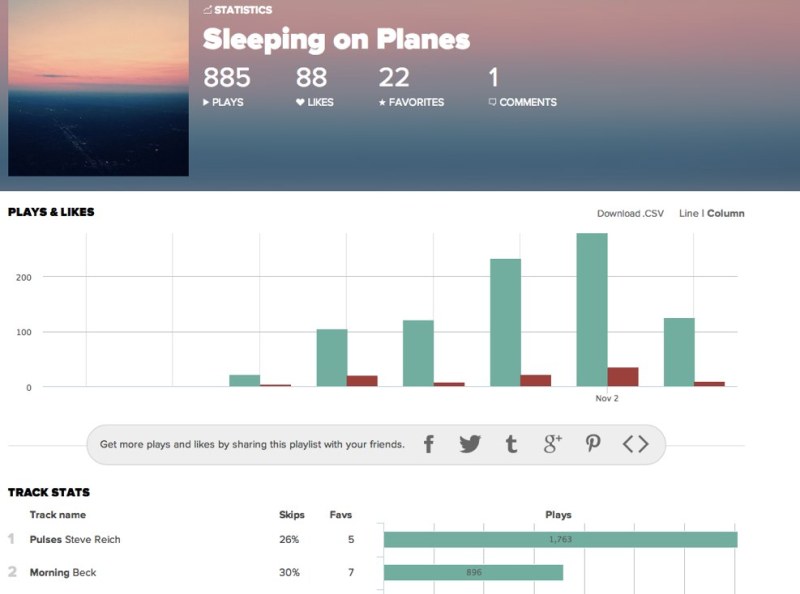
Analytics for DJs to get listeners’ feedback
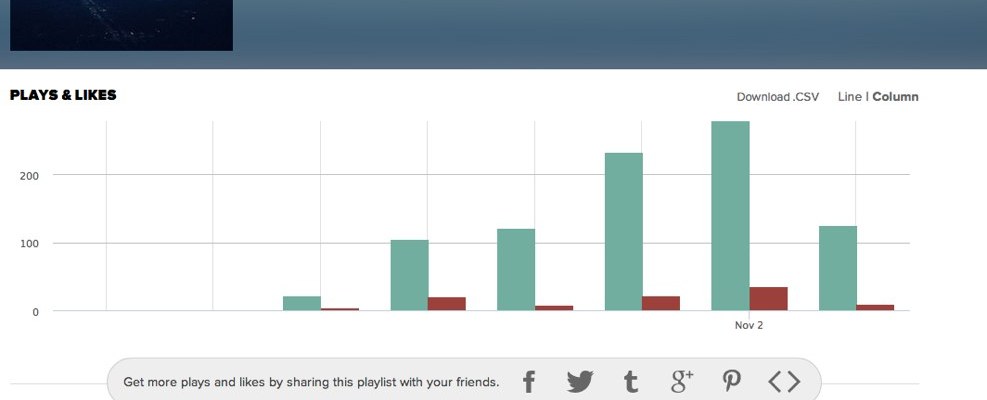
For the first time, DJs can access an analytics dashboard that gives them stats about their playlists. It highlights the number of times a playlist’s songs have been listened to, liked, or skipped, and provides DJs with feedback from their listeners to help them make even better playlists.
Real-time feedback from listeners
DJs now have a notification feed that enables them to monitor the success (likes, comments, follows) of their playlists and the growth of their listenership. Everyone needs a little encouragement. Go on, enjoy your new adoring fans!
“Personalized tags” to help discover playlists you love, faster
We did not forget about our listeners! The new web version learns a listener’s music taste using their listening activity (liking, browsing, favoriting), suggesting relevant search tags that can help them discover playlists they’ll hopefully love.
Today we’re beyond excited to unveil the latest advancement in playlist technology: 8tracks 3.0 on Android, available as of today on Google Play. Coming on the heels of a complete redesign of our iPhone, iPad, and Xbox apps earlier this year, the new release features a similar improvement of the design and navigation we brought to those apps. This means we officially have a complete roster of new apps in time for the new school year, which experts predict will improve student test scores by as much as 1000%.
As many of you know, we’ve seen a big uptick in iOS (iPhone and iPad) listening since release of our 2.0 version of that app last October. At the time, iOS comprised 22% of our total hours streamed. Ten months on, in August, iOS has jumped to represent 49% of our hours streamed.
However, listening on Android hasn’t seen as much of a shift. Last October, Android chalked up 9% of our hours streamed; last month, it just tipped 10%. So we’re making a big investment in Android, and Martin Marconcini joined us in the spring to help take things to the next level.
In October, we’ll be releasing our 3.0 version of the Android app, and it’s going to be hot. However, there’s some cool features we wanted to introduce sooner, and so we released 8tracks v2.2.10 last week.
Google+ sign in
We like Google+ and know it’s a first class citizen in the Android world. So we went ahead and added Google+ sign in, giving you an alternative to Facebook.
Bluetooth, Home Screen Widget & Remote Control
Many listeners requested we support these features again, so they could control 8tracks from supported devices. While this will run 8tracks in the background, it’s by design — that’s the Android way! (Note that what runs in the background is small and only controls the above features.)
On Monday, we launched a revamp to the 8tracks website. We think it’s a big step up on several fronts:
Homepage navigation
A proper Feed
Clean & minimal design
Homepage navigation
The homepage now offers one-click access to the 3 critical paths for enjoying 8tracks — Home, Feed & Explore — from any page on the site.
HOME lets you quickly pick up where you last left off (“Resume”), even if your last listening session was on mobile. And if you want to “change the channel” you can readily jump to any category you’ve previously preferenced:
Mixes you’ve simply listened to in the past (Listening history)
Mixes you’ve liked or collected (Liked mixes, Collections)
Tracks you’ve favorited (Favorite tracks)
Tags you’ve either visited frequently or actively “preset” (Presets)
Mixes we THINK you’ll like, based on mixes you’ve liked in the past (Recommended for you)
The new FEED (discussed below) allows you to discover new mixes and music through your social graph — people you follow on 8tracks.
And the EXPLORE section is now more readily (or at least obviously) accessed, allowing you to discover new mixes and music based on some combination of activity, mood and genre tags.
A proper Feed
While 8tracks is fundamentally a social network, we’ve largely eschewed many of the trappings of a typical social network feed. With this 3.0 website revamp, we’ve placed a new Feed front and center. The new Feed includes 2 types of items (for now, but more to come):
Mixes published by DJs you follow (we’ve always had this in the form of the “Mix feed”)
Mixes LIKED by listeners you follow (there’s now a reason to follow other listeners who’ve similar taste)
We think the Feed will allow you to better tap others for unearthing gems of interest on the network.
Clean & minimal design
The old version of the site had evolved incrementally, and we felt it was time for a bit of a refresh. The new site:
Removes unnecessary borders
Adopts a sexy new font (well, we think so)
Increases the size of mix art in our “list” view while retaining the option for a visually-focused “grid” view
Offers you the ability to filter any list of mixes by key criteria (Feed, Liked, Trending, Newest & Popular)
Unifies presentation across page types (home, profile, mix)
We’ve always prided ourself on a simple, focused and compelling design, and this ups the ante.
We hope you like the changes and, as always, welcome feedback. We’ll be introducing 3.0 versions of both our iOS and Android apps this fall so stay tuned!
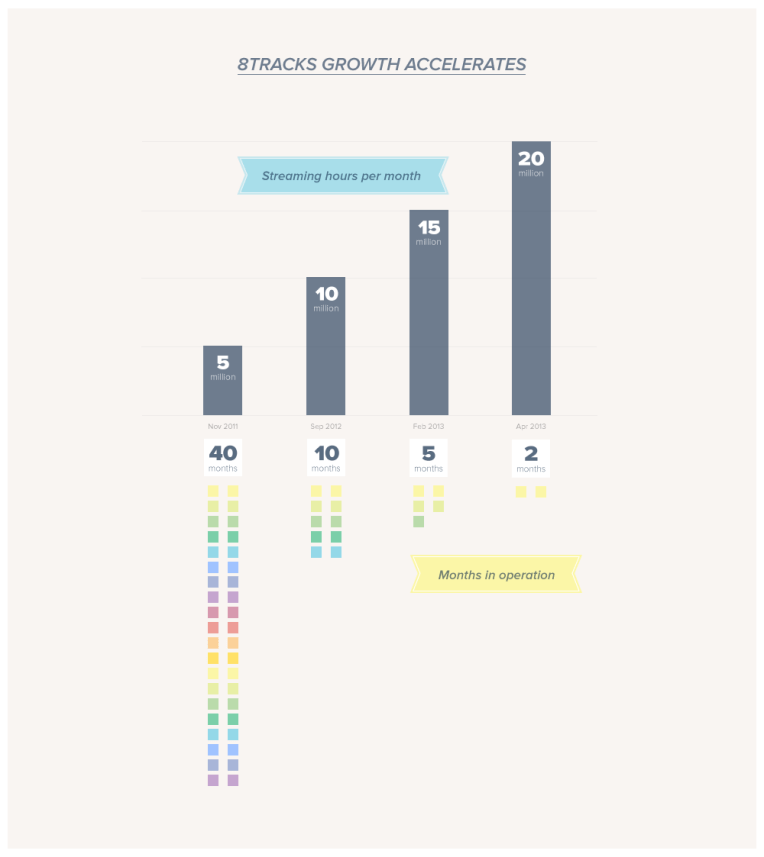
As we prepare for our 5th birthday party here in the 8tracks loft, we thought it’d be fun to show you the steady — and now accelerating — growth that you’ve helped us achieve.
8tracks reached 5m streaming hours *per month* in Nov 2011 — 40 months after its launch in Aug 2008. We reached 10m hours by Sep 2012 — 10 months later — and 15m hours in half that time. We added another 5m hours in only 2 months and now consistently top 20m streaming hours per month.
Thanks again for your dedicated listenership! We look forward to making 8tracks an even better place to discover and enjoy music in the days and years to come.
Recent media coverage of the digital music sector has tended to lump all types of music streaming — notably, the radio-style delivery of Pandora and the on-demand access of Spotify — in the same bucket.
In fact, these two primary types of music consumption are quite different in terms of:
Value proposition
Market size
Competition
Business model
Royalty expense
There’s way too much to cover in one post, so I thought it’d be useful to drill down on each of these points of differentiation in a series of shorter entries. Let’s start first with the value proposition.
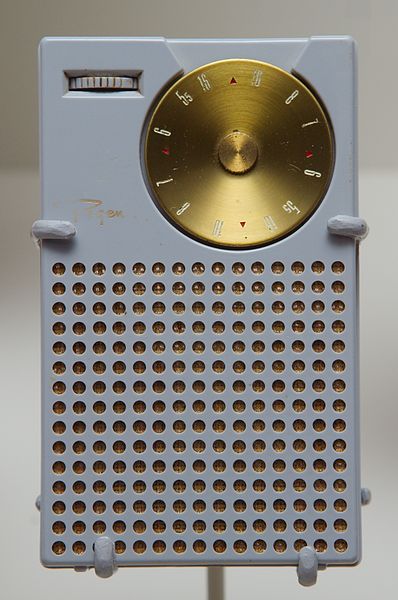
The Regency TR-1 transistor radio
RADIO
One helpful way to think about online music services is to consider their historical analogs. Internet radio — what Pandora, Clear Channel’s iHeartRadio, 8tracks, Songza, Slacker and others offer — is designed to function just like regular (terrestrial) radio: listeners pick a category of programming (e.g. music of a format or genre, for an activity or mood, or that “sounds like” one or more artists), hit play, and then tune in passively.
People who listen to radio — whether delivered over the air, via cable, satellite or internet — benefit because music has already been selected, reducing their time and effort. Listeners can be lazy. Unlike the 30-60 minute format of television or the 90-120 minute format of film, the five-minute format of music lends itself to “packaging” so that a listener doesn’t have to keep returning to his device time and again to pick another track. While the album accomplishes this objective to a certain extent, radio offers longer listening and greater variety.
Because radio is programmed by people or algorithm for long-form listening to a variety of artists, it is also the primary means for music discovery (for listeners) and promotion (for artists). This has always been true of traditional radio, albeit less so since the homogenization of the airwaves in the wake of deregulation in 1996. And it is even more true for internet radio, where spectrum isn’t scarce. Pandora plays a wider variety of music than terrestrial radio, and 8tracks extends even further down the Tail, with two in three tracks streamed from independent labels or artists.
As internet radio becomes increasingly ubiquitous, more artists have the opportunity for meaningful exposure, and more listeners have the opportunity for meaningful discovery.
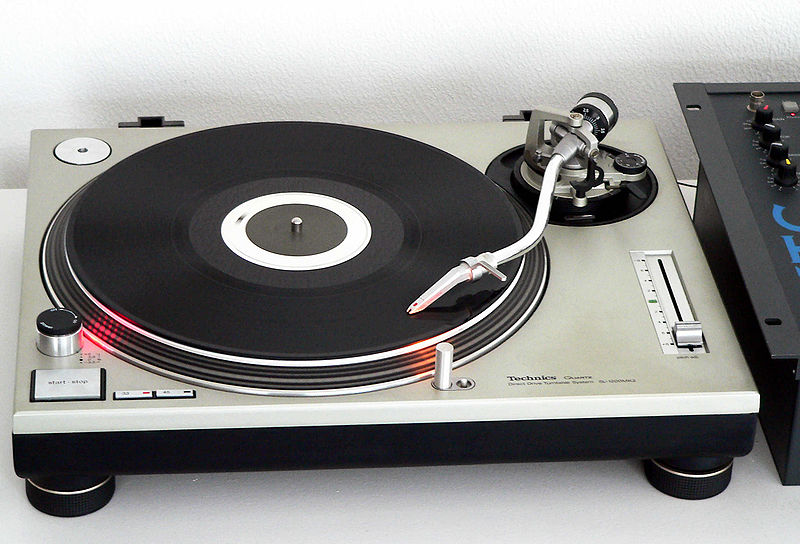
The Technics SL-1200 turntable
ON-DEMAND
While internet radio is the heir to terrestrial, cable and satellite radio, on-demand streaming—what Spotify, Deezer, Rhapsody, Rdio, Daisy/MOG and others offer—is the natural successor to older forms ofinteractive listening. From vinyl to (ahem) 8-track to cassette to CD to (most recently) digital download, sound recording formats have evolved relatively quickly over the last 50 years. But across all of these formats, the objective is the same: listeners pick a specific song or album or artist, hit play, and then tune in on demand, whenever and as often as desired.
People who listen to a CD, download or on-demand stream benefit from tuning into exactly the music they already know and love. Physical formats for recorded music are purchased and “owned” in the normal sense; digital downloads are sometimes purchased and may be hosted locally or in the cloud. A listener can stream a file she’s uploaded to a “music locker” in an on-demand manner. However, the most widely used on-demand services are those that offer a large, pre-populated catalog of music and require (or seek) a subscription rental fee.
The most voracious music consumers no doubt stand to see the most value from on-demand subscription services: rather than pay $1 for a track on iTunes or Amazon, they can instead stream it — and pretty much any other track that comes to mind — fully gratis on Spotify (subject to ads) or for $5-10 per month on any of the other on-demand services. The relative value proposition to an artist depends on how much a listener tunes in, as the rumored magnitude of Spotify’s sound recording royalty ($0.003 per play) suggests that ~200 plays of a given track would be required for an artist to earn as much revenue as they would from the sale of a download. By way of comparison, Last.fmscrobbling indicates I’ve listened to Moderat’s A New Error more than any other track, for a total of 144 times.
—
Radio (Pandora) makes it easy to listen to a particular style of music, with less control but the ability to be lazy; once I’ve discovered new music through radio or friends, I can listen to exactly that track or artist, whenever I want, on an on-demand service (Spotify). The former promotes the sale or rental of music, while the latter — a rental model itself—largely replaces the need for listeners to purchase downloads on iTunes or another digital music store.
In my next post, I’ll highlight the size of the markets for these two types of music consumption.



 8tracks blog